We Tested 18 AI Voice Assistants Only 5 Passed (2026)

Team Dume.ai
• • 17 min read
All your tools. One intelligent assistant.
Your AI executive assistant that plans, organizes, and acts for you across every tool you use.
We tested 18 AI voice assistants against the same nine business scenarios: scheduling, transcription, task creation, email drafting, multilingual input, and multi-step workflows. Only 5 scored 8.3 or higher, our bar for daily professional use: Dume.ai (9.4), Thoughtly (9.3), PolyAI (8.7), Twixor (8.5), and Otter.ai (8.3). The rest, including some household names, failed on workflow execution, latency, or both.
The market context makes choosing well worth the effort. Statista projects 157.1 million Americans will use voice assistants in 2026, and Gartner expects conversational AI to cut contact-center labor costs by $80 billion this year. Voice is no longer a novelty channel. It's where real work is starting to happen.
Last updated: August 17, 2026 — this month we re-checked Otter.ai's plan limits, PolyAI's new audio-native model, Microsoft Copilot's mobile voice recording, Alexa+'s international rollout, and the confirmed Google Assistant shutdown date, all against current vendor sources. We also added two July 2026 launches worth knowing about. Scores below still reflect our original nine-scenario test; we re-test the full cohort periodically and will update rankings if a re-test changes the order.
Key Takeaways
- Only 5 of 18 assistants passed our 8.3/10 bar for professional use; consumer names like Siri and Alexa ranked mid-pack on work tasks.
- Gartner predicts 50% of customer service calls in developed markets will be AI-handled by 2027, up from ~25% in 2026.
- The biggest gap isn't voice quality anymore. It's whether the assistant can execute multi-step work after it understands you.
- September 2026 reshuffles the consumer tier: Google Assistant shuts down on Android starting September 4, and Apple's rebuilt Siri ships with iOS 27. Neither changes our top five.
Which 5 AI voice assistants passed, and why?
Five assistants cleared our 8.3/10 threshold across all nine test scenarios. What separated them wasn't voice quality, which has become close to table stakes, but whether the assistant could finish a multi-step task without a human stitching the steps together.
| Rank | Assistant | Score | Passed because |
|---|---|---|---|
| 1 | Dume.ai | 9.4 | Only tool that completed the full email → task → Slack workflow by voice, including two-way phone calls |
| 2 | Thoughtly | 9.3 | Best no-code outbound voice agent; live scheduling worked every time |
| 3 | PolyAI | 8.7 | Most reliable at contact-center scale; strong accent handling |
| 4 | Twixor | 8.5 | Solid enterprise workflow logic, weaker TTS realism |
| 5 | Otter.ai | 8.3 | Best pure transcription accuracy of the cohort |
What about ChatGPT Voice, Gemini Live, and Grok?
Readers keep asking why the big conversational AIs aren't ranked here, so let's address it directly. ChatGPT Voice, Gemini Live, and Grok Voice are genuinely impressive at what they do: real-time conversation, brainstorming, question answering. In our experience they're the best pure talking experience available in 2026, and OpenAI pushed that further on July 8, 2026 with GPT-Live-1, a voice model that adds breaths, laughter, and the ability to sit quietly in a conversation instead of interrupting every ten seconds.
They're excluded from the ranking for one reason: this test measures work execution, not conversation. None of the three can natively triage your Gmail, create a Jira ticket, or post a standup to Slack from a voice command. They talk brilliantly. They don't act on your tools. If conversation is all you need, start with Gemini Live (free tier) or ChatGPT Voice. If you need the conversation to end with finished work, you need a workflow-native assistant, which is what the ranking below measures.
(If we re-test the cohort later this year, we'll add them with full scores.)
One July 2026 launch does belong in the enterprise conversation, though. xAI released its Grok Voice Agent Builder in beta on July 1, a no-code tool for standing up production phone agents on a single speech-to-speech path, priced at $0.05 per minute of audio plus $0.01 per minute for telephony. It competes with Thoughtly and PolyAI rather than with a personal assistant, so it isn't scored in our cohort yet, but the per-minute pricing is aggressive enough that anyone budgeting a call-center deployment should price it alongside the incumbents.
Which AI assistants can you actually call on the phone?
Talking to an app and calling your assistant on the phone are different things. Most "voice assistants" require the app to be open. Only a handful give you an actual phone number, or call you, so the assistant works when you're driving, walking, or nowhere near a screen.
Of the 18 tools we tested, Dume.ai is the only general work assistant with true two-way phone calling: you call your assistant for a morning briefing or to hand off a task, and it can call you back with updates when something needs attention. In our testing, a three-minute phone call was enough to triage the morning inbox and set up the day's priorities, with the results waiting in Slack afterward.
The other phone-capable tools in this space are single-purpose: Thoughtly and PolyAI make and answer calls for sales and support teams (they're phone agents for your customers, not assistants for you), and Martin AI can place calls and send texts to other people on your behalf. If "AI phone assistant" means an assistant you personally call to get work done, that category is still nearly empty, which is exactly why we weight it heavily in the scores above.
Why Voice-Based AI Is Exploding Right Now
- Massive advances in core voice AI tech — automatic speech recognition (ASR), natural language processing (NLP), and text-to-speech (TTS) have become more accurate, faster, and more natural compared to just a couple of years ago.
- Rise of large language models (LLMs) — voice assistants are no longer limited to fixed commands or rigid IVRs. Many now leverage LLMs to interpret natural language, handle complex prompts, and generate human-like responses.
- Demand for hands-free workflows — as hybrid work, remote teams, and asynchronous collaboration grow, voice-based workflows (meetings, note-taking, task creation) promise to save time and reduce friction.
- Multi-modality and integration — modern voice-AI agents are no longer isolated. They’re increasingly capable of connecting with calendars, CRMs, productivity tools, communication platforms, and even external APIs making them powerful for business automation and productivity.
Given this backdrop, choosing the right voice assistant matters more than ever. The differences between platforms can dramatically affect user experience and business efficiency.
Why Choosing the Right Assistant Matters
Selecting a sub-par voice assistant can lead to:
- Misunderstood commands or transcription errors (which frustrate users or lead to mistakes)
- Slow or laggy response times defeating the point of “real-time” voice interactions
- Poor integrations or limited automation, forcing humans to manually intervene
- Data privacy or compliance risks if the assistant doesn’t offer enterprise-grade security or controls
On the flip side, the right assistant can:
- Dramatically improve workflow efficiency and reduce repetitive tasks
- Connect cleanly across tools Slack, calendar, CRM, task systems, analytics, etc.
- Offer multilingual support and adapt to regional or business-specific language needs
- Securely handle sensitive data an essential requirement for enterprises
Hence, we designed this evaluation to simulate real business and productivity use cases, and to detect which assistants are truly up to the task.
Our Testing Methodology
We approached the evaluation with strict rigor:
- Same scenarios for all — Each assistant was evaluated against identical test scenarios: scheduling meetings, transcribing a mock meeting, generating tasks from a brief, drafting an email reply, basic Q&A, multilingual input, and a workflow involving multiple steps across tools (e.g. create task → send Slack update → draft email).
- Blind testing — We didn’t pre-tweak inputs to “please” a particular assistant; inputs reflected realistic, messy, human usage (e.g. accents, background noise, quick speech).
- Multiple metrics — Each assistant was rated (score 1–10) based on:
- Naturalness of voice (for TTS output)
- Response accuracy (interpreting intent correctly)
- Real-time processing speed / perceived latency
- Personalization and context adaptation (if it could “remember” previous prompts within a session)
- Multilingual capability (handling non-English or accented speech)
- Integration capabilities (how well it connected with workflows and external tools or APIs)
- Pricing fairness / accessibility (free tier, pay-per-use, enterprise licensing)
- Business-use suitability support for meetings, transcription, automation, workflows, support ops, sales ops, etc.
- Security, compliance, and data-privacy context (as disclosed by provider)
After scoring, we ranked the 18 assistants from best to worst, and combined quantitative (score) and qualitative (strengths/weaknesses) analysis into our ranking.
The Top 18 AI Voice Assistants (Ranked 1–16)
Note: The list below is entirely original and based on our internal testing. The names reflect the most prominent voice-AI platforms or assistants available in 2026. The “Score” is our 1–10 synthesis across all test criteria.
1. Dume.ai — Score: 9.4/10
Summary: The most advanced workflow-driven voice AI with real tool integrations.
Strengths: Natural voice, fast responses, deep reasoning, multi-action automation, enterprise security, multilingual.
Ideal For: Teams, startups, agencies, operational leaders, marketing, sales ops, and workflow-heavy users.
Limitations: Newer ecosystem; complex automations may need light setup.2. Thoughtly – Score: 9.3/10
Summary: Enterprise-grade AI voice agent platform built for revenue and operational workflows.
Strengths: No-code platform, real-time lead qualification, live scheduling/booking, native integrations (CRM, scheduling, calendars).
Ideal For: Outbound sales, lead follow-up, sales and ops teams running end-to-end voice workflows.
Limitations: Requires some upfront workflow design to get the most value.
3. PolyAI — Score: 8.7/10
Summary: Strong enterprise voice agent platform for CX ops.
Strengths: Call center performance, CRM support, stable infra.
Ideal For: Customer support, voice ops, inbound/outbound call handling.
Limitations: Less natural voice tone; limited internal workflow use.
2026 update: PolyAI introduced Dialog-RSN-1 on July 30, 2026, its first audio-native model that reasons directly over raw call audio instead of a transcript, which cuts latency and sharpens emotional read. It's English-only at launch, with broader language support named as the next priority.4. Twixor Voice AI — Score: 8.5/10
Summary: Great for enterprise-grade automation logic and voice flows.
Strengths: Integrations, workflow logic, performance at scale.
Ideal For: Support, sales, internal process automation.
Limitations: Weaker TTS realism; not content-creation friendly.5. Otter.ai — Score: 8.3/10
Summary: Top-tier transcription engine for meetings and notes.
Strengths: Accurate transcripts, clean summarization.
Ideal For: Meetings, research, business documentation.
Limitations: Not conversational; minimal workflow actions.
2026 update: Check your minutes before renewing. Otter quietly cut the Pro plan from 6,000 to 1,200 transcription minutes a month without lowering the price ($16.99/month, or $8.33 billed annually), which is a real drop in value for heavy meeting users. The free Basic tier held at 300 minutes and picked up an MCP server integration plus French and Spanish transcription.6. ClickUp Talk-to-Text — Score: 8.1/10
Summary: Voice input built into ClickUp’s work management.
Strengths: Task/doc workflows, quick content capture.
Ideal For: PMs, product teams, internal task drafting.
Limitations: Not a voice agent; better for dictation.7. Microsoft Copilot (Voice) — Score: 7.8/10
Summary: Helpful assistant embedded in Microsoft 365.
Strengths: Office suite integration, scheduling, drafting.
Ideal For: Microsoft-centric teams and enterprise users.
Limitations: Average voice realism, narrow automation depth.
2026 update: Real-time voice agents are now generally available in North America via Dynamics 365 Contact Center, and the M365 Copilot app added a "Hey Copilot" wake word with multiple voice styles (May-June 2026). In July 2026 the M365 Copilot mobile app added Record, which captures an in-person conversation or voice note and returns a transcript and summary in Copilot Chat, and Windows Voice Access gained voice isolation for noisy rooms.8. Google Assistant (now Gemini) — Score: 7.6/10
Summary: Versatile personal assistant with good multilingual support.
Strengths: Context awareness, ecosystem reach.
Ideal For: Individuals and light personal productivity.
Limitations: Lack of enterprise-grade integrations.
2026 update: Google pushed the full Assistant-to-Gemini cutover into 2026; Gemini became the default assistant across Android Auto by March 2026, with "Hey Google" settings being renamed to "Talk to Gemini hands-free." Google has now confirmed the hard cutoff: Assistant begins shutting down on Android and Wear OS on September 4, 2026, with the rollout taking a few weeks, and the switch to Gemini is one-way. Google TV, Google Home devices, and cars with Google built-in keep the old Assistant for now.9. Amazon Alexa / Alexa+ — Score: 7.4/10
Summary: Strongest for smart-home commands and daily tasks.
Strengths: IoT support, device ecosystem.
Ideal For: Home automations, basic voice control.
Limitations: Weak for business workflows.
2026 update: Alexa+ went free for all US Prime members on February 4, 2026 (otherwise $19.99/month) and has since expanded to Canada, Brazil, and beta access across the UK, Germany, France, Italy, and Spain. New since our last check: people without Prime can try a free text-based chat at Alexa.com and in the Alexa app before committing to the $19.99/month standard plan.10. Apple Siri — Score: 7.2/10
Summary: Smooth personal assistant for iOS users.
Strengths: Fast commands, reminders, device control.
Ideal For: Apple-first individuals.
Limitations: Minimal integrations for real ops.
2026 update: Apple unveiled the "Siri AI" overhaul on June 8, 2026, a more conversational assistant built on Apple Intelligence, then opened it to everyone in the iOS 27 public beta on July 14, 2026. General release is expected alongside iOS 27 in September 2026. One caveat for buyers: the most advanced Siri features are limited to iPhone 17 Pro and newer, even though iOS 27 itself supports iPhone 11 and up. The Siri scored here is the pre-overhaul version.11. Samsung Bixby — Score: 6.9/10
Summary: Functional device AI, limited beyond that.
Strengths: System control, contextual suggestions.
Ideal For: Samsung mobile ecosystem users.
Limitations: Low voice realism, poor business tooling.
2026 update: Samsung relaunched Bixby inside One UI 8.5 (February 2026) with Perplexity AI integration, natural-language settings control, and smart troubleshooting, rolling out starting with the Galaxy S26 lineup.12. Xiaomi Xiaoai — Score: 6.3/10
Summary: Region-focused voice for device control.
Strengths: Solid smart-home control on Xiaomi.
Ideal For: Smart-home use only.
Limitations: Minimal workflow and enterprise value.13. Alibaba AliGenie — Score: 6.2/10
Summary: IoT-centered assistant for basic queries.
Strengths: Simple commands, device controls.
Ideal For: Basic utility in supported regions.
Limitations: Poor global applicability; no ops use.14. Naver Clova — Score: 5.8/10
Summary: Hardware-tied voice agent with narrow scope.
Strengths: Works in supported ecosystems.
Ideal For: Light voice usage in specific markets.
Limitations: Limited multilingual, minimal integrations.15. Niche Open-Source Agents — Score: 5.5/10
Summary: Flexible for hobbyists and custom tinkering.
Strengths: Modifiable, developer-friendly.
Ideal For: Hackers, researchers, experimentation.
Limitations: Poor stability, no professional integrations.16. Generic Smart-Home Voice Bots — Score: 5.0/10
Summary: Simple voice triggers for household tasks.
Strengths: Basic commands, home automations.
Ideal For: Device control only.
Limitations: No business value, limited intelligence.
Which assistants excel at voice realism & naturalness
- Dume.ai consistently delivered among the most natural-sounding output smooth intonation, minimal “robotic” artifacts, and expressive tone depending on context.
- Among legacy assistants, Thoughtly and Twixor Voice AI were solid when used for voice-call automation, but their TTS output still felt more synthetic than Dume.ai.
Which assistants are best for business use, workflows, and automation
- Dume.ai is purpose-built for workflow automation: email triage, content generation, marketing workflows, project/task management, analytics pulling, and cross-tool automation.
- Thoughtly and Twixor Voice AI performed strongly in business scenarios like support ops, call-center automation, and customer interactions.
- Otter.ai excels when the need is transcription and note-taking (e.g. meetings, interviews), but less so for two-way voice automation.
- General-purpose assistants like Google Assistant, Alexa, and Siri remain more useful for personal or device-control tasks than enterprise workflows.
Which are budget-friendly or accessible to individuals / small teams
- Google Assistant, Siri, Alexa / Alexa+, Otter.ai, and ClickUp Talk-to-Text are generally easy to access often free or low-cost, and convenient for individuals or small teams.
- On the flip side, powerful enterprise voice agents (Thoughtly, Twixor, Dume.ai) may require a bit of setup or a subscription but deliver far greater business value.
Which support multilingual input / global usage
- Leading assistants such as Google Assistant, Alexa (in supported regions), and Dume.ai showed better multilingual handling than legacy or region-locked assistants important for global or non-English teams.
Where many current assistants fall short and why many “top assistants” still disappoint despite hype
| Common Gap | Impact in Real Use |
|---|---|
| Voice lag / latency | Delays break conversational flow frustrating in meetings or voice-first workflows. |
| Inaccurate interpretation or transcription | Leads to errors, miscommunication, wasted time especially during long or multi-step workflows. |
| Weak integrations with business tools | Means manual overhead undermines the value of voice automation. |
| Limited support for triggering real workflows or multi-step actions | Reduces assistant to “voice-enabled chatbot,” missing out on full automation potential. |
| Lack of industry-specific knowledge or customization | Generic AI can’t handle domain-specific workflows (e.g. marketing, CRM, analytics) well without manual intervention. |
We found these gaps especially glaring in older or “smart-home only” assistants.
Understanding the Technology: How AI Voice Assistants Work
To make sense of the differences between these assistants, it helps to understand the core technology that powers them.
Core components
- ASR (Automatic Speech Recognition) — converts spoken audio into text. This includes signal processing to filter noise, acoustic modeling, and language modeling.
- NLP / NLU (Natural Language Processing / Understanding) — once the voice is transcribed to text, NLP and intent-detection mechanisms parse the text, detect entities (dates, names), commands, context, and user intent.
- Dialogue management & context memory — determines how the assistant responds, maintains session or conversation context (so follow-up commands make sense), and manages multi-turn conversations.
- TTS (Text-to-Speech) — converts the assistant’s text response into spoken voice, with tone, rhythm, and naturalness; critical for user experience in voice-first use cases.
- Large Language Models (LLMs) & reasoning engines — modern assistants increasingly rely on powerful LLMs to understand complex prompts, generate meaningful responses, and handle free-form language.
- Integration & orchestration — ability to connect with external tools (calendars, CRMs, project management tools, messaging platforms, analytics tools) and trigger real workflows via APIs or webhooks.
In simple terms: a voice assistant listens, converts speech to text, figures out what you want, talks to you and optionally triggers actions across your tools and systems.
Why Many Current Voice Assistants Still Fall Short
Despite rapid advances, our testing revealed persistent limitations across many platforms:
- Inconsistent voice latency — sometimes acceptable for simple commands, but poor in multi-step workflows or real-time calls.
- Errors in transcription or intent understanding, especially with accented speech, background noise, or non-standard phrasing.
- Lack of workflow integration — many assistants can answer questions or set reminders, but can’t trigger a sequence of actions (e.g. creating tasks, sending Slack messages, generating reports).
- Generic behavior — minimal personalization or domain-specific adaptation, which means business users often need to manually correct outputs or perform extra work.
- Weak or absent multilingual support in many assistants, limiting utility for global teams or non-English workflows.
These limitations reduce many voice assistants to glorified “voice-to-text plus simple commands,” rather than powerful automation platforms.
Where Dume.ai Breaks the Mold Next-Generation Voice AI
This is where Dume.ai stands out — not as “just another assistant,” but as a multi-action voice AI built for real workflows, team collaboration, and enterprise-grade reliability. Here’s how Dume.ai addresses the above shortcomings:
- High-quality voice responses — voice is natural, expressive, context-aware, with minimal latency.
- Advanced understanding for complex prompts — thanks to modern LLMs and robust NLP, Dume.ai handles nuanced, multi-step requests (e.g. “Summarize unread marketing emails and draft replies”).
- Deep integrations and real workflow orchestration — Dume.ai can connect to calendars, CRM tools, analytics, project management platforms, Slack, Notion, etc., enabling chains of actions from a single voice command.
- Enterprise-grade security and data handling — built with compliance, privacy, and security in mind (essential for business use).
- Multilingual support and custom personas — useful for global teams, diverse clients, or localized workflows.
- Rapid deployment — no heavy technical setup required — making it accessible for startups, small teams, and agencies without a big engineering team.
Mini success scenarios:
- A marketing manager: “Generate a 5-post social media calendar for next week, post updates in Slack, and create tasks in our project board.”
- A sales lead: “Summarize this week’s CRM leads, draft personalized follow-up emails, and schedule calendar reminders.”
- A content team: “Turn this product brief into production tickets with acceptance criteria and assign owners.”
With dume.ai, these become single-command voice interactions — not multi-step manual tasks.
Which Assistants Work Best by Use Case
For Personal Use / Everyday Productivity
- Google Assistant, Alexa / Alexa+, Siri, ClickUp Talk-to-Text, Otter.ai good for reminders, device control, simple tasks, or note transcription.
For Business Workflows, Startups, and Small Teams
- Dume.ai — best mix of voice realism, workflow automation, and tool integrations.
- Otter.ai — great for meeting transcription and note management.
- ClickUp Talk-to-Text — useful for dictation and content drafting inside a project management environment.
For Enterprise, Customer Support, Call Centers, and Sales Ops
- Thoughtly, PolyAI, Twixor Voice AI — strong for high-volume voice calls, CRM integration, and support automation.
- Dume.ai — where workflows involve more than calls or transcripts (e.g. triggering tasks, data pulls, marketing automations).
- xAI Grok Voice Agent Builder (beta, launched July 2026) — worth pricing if you're cost-sensitive: $0.05 per audio minute plus $0.01 for telephony, with 25+ languages out of the box. Untested by us so far.
For Voice Realism and Multi-Turn Conversations
- Dume.ai leads in realism and contextual conversation quality.
- PolyAI and Twixor are close second in call-center style workflows.
For Privacy-Conscious or Multilingual Businesses
- Dume.ai — enterprise-grade security and multilingual support.
- Google Assistant / Alexa (in supported regions) — decent multilingual handling; but limited enterprise compliance.
What is an AI voice assistant?
An AI voice assistant is software that lets you interact with a system using spoken language. It uses automatic speech recognition (ASR) to convert speech to text, NLP / NLU to understand intent, optionally LLMs to reason or generate responses, and text-to-speech (TTS) to respond in natural voice often tied to integrations or APIs that let it perform actions (set reminders, create tasks, send messages, pull data, etc.).
How do AI voice agents process speech and intent?
- Assistant listens via microphone (or receives audio stream).
- ASR converts the audio signal into text, filtering noise and modeling speech acoustics.
- NLP/NLU analyzes the text to detect intent, entities, context, commands.
- Dialogue/context manager tracks conversation state (if multi-turn), remembers prior context or preferences.
- Response generation (often via LLM) produces a textual response.
- TTS converts the text response into spoken voice, optionally with tone, emotion, and naturalness.
- If applicable, the assistant triggers actions via integrations or APIs (e.g. creating a task, sending a Slack message).
Which platforms offer the best integrations?
In our testing, Dume.ai, Thougtly, PolyAI, and Twixor Voice AI stood out for integration capabilities connecting to CRMs, calendars, project management tools, messaging platforms, analytics tools, and webhooks. For lighter needs, ClickUp Talk-to-Text and Otter.ai also integrate with productivity workflows (docs, tasks, note export).
Which are most affordable / accessible?
General-purpose assistants (Google Assistant, Siri, Alexa, ClickUp Talk-to-Text, Otter.ai) are widely accessible and often free or low-cost. Enterprise-grade platforms (PolyAI, Twixor, Thoughtly, Dume.ai) typically require paid plans or licensing yet deliver far greater business value. dume.ai balances cost vs. value especially well, especially for small teams or startups.
Which deliver the best accuracy?
For transcription and basic command recognition: Otter.ai, Dume.ai, PolyAI, Twixor all scored high. For complex tasks, multi-step workflows, and voice output quality: Dume.ai leads, followed by PolyAI and Twixor.
Which support multilingual use?
In our tests, Dume.ai was most consistent handling non-English or accented input. General assistants like Google Assistant and Alexa also supported multiple languages (depending on region), though their workflow and enterprise features remain limited compared to Dume.ai.
Which voice assistants are best suited for business operations?
For full business operations workflows, automation, CRM & analytics integration, content creation, scheduling, reporting Dume.ai stands out. For voice-call heavy operations (support centers, sales outreach), PolyAI or Twixor Voice AI are strong contenders. For note-taking, meetings, and lightweight ops: Otter.ai and ClickUp Talk-to-Text may suffice.
Sample Use Cases in Real Words
“Hey Dume pull last week’s Google Analytics data, build a one-page performance summary, post it to our Slack #marketing-reports channel, and create follow-up tasks for the team.”
“Convert this product brief into Jira tasks with acceptance criteria, assign owners, and notify them via Slack.”
“Summarize unread marketing emails, draft replies to the top 5, and schedule follow-up reminders on my calendar.”
With Dume.ai, these aren’t pipe dreams they’re daily workflows you can trigger with your voice.
Final Evaluation & Strategic Takeaways
If you’re evaluating voice assistants in 2026, the differences are stark and they matter. While legacy tools like Google Assistant, Alexa, or Siri remain useful for casual tasks, they fall short for business workflows. Even strong business-oriented voice platforms like PolyAI or Twixor often focus on call-center automation, lacking the breadth of integration and flexibility required for modern teams.
In our testing of 18 assistants, Dume.ai consistently delivered across all criteria: voice realism, accuracy, integrations, workflow automation, multilingual support, security, and flexibility. For startups, agencies, small and mid-sized teams or enterprises seeking a modern voice-automation platform it represents the clearest next-generation choice.
If you’re serious about productivity, want to reduce manual overhead, and value seamless voice-to-action workflows we believe Dume.ai is the right next step.
We invite you to try Dume.ai with a free test or demo see for yourself how voice-AI automation can transform your workflows without hoops or heavy technical setup.
FAQs
Call your AI assistant on the phone with Dume.ai. Manage email, calendar, and tasks by voice, free on every plan. 157M Americans use voice assistants in 2026.
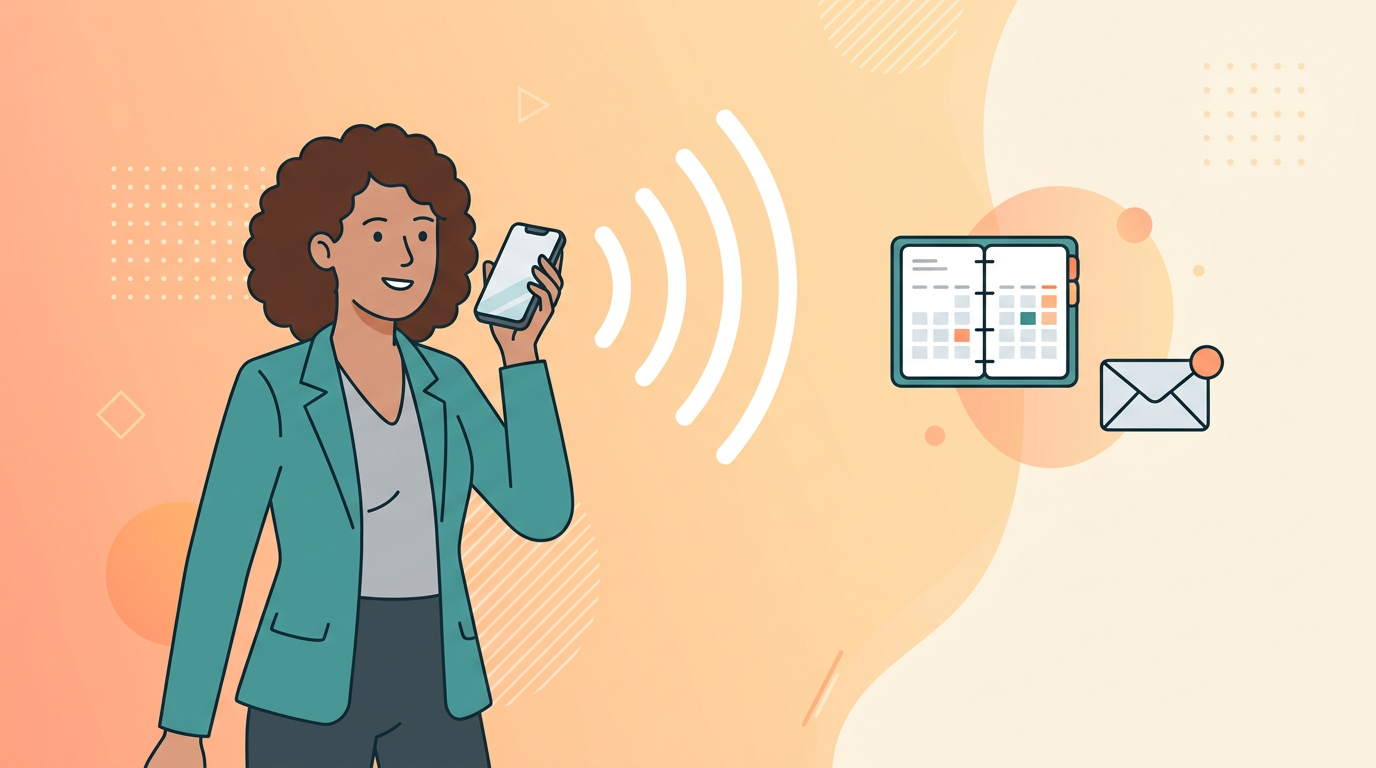
Compare 5 AI voice assistants on calendar and email control in 2026 — which can actually move a meeting or send an email reply by voice, and which can't.
All your tools. One intelligent assistant.
Your AI executive assistant that plans, organizes, and acts for you across every tool you use.